Do You Understand GEO or Are You Just Guessing?
MencionAI Blog Pedro Quintian
MencionAI Blog Oct 07, 2026 · 4 min read / GEO
Do You Understand GEO or Are You Just Guessing? MencionAI explains this for teams that want to be cited in ChatGPT, Gemini, Claude, and Google AI Mode.
Quick answer
No. SEO ranks links on a results page. GEO measures whether your brand is cited inside AI answers on ChatGPT, Gemini, Claude, Perplexity, Grok, and DeepSeek.
Summary
- False. SEO ranks pages in a list of results; you compete for clicks.
- False. Generative AI models are not deterministic by default.
- False. There is a second mechanism, real-time search, that comes into play when the model searches the web during the response.
- True. A brand with a generic name, or one that shares a name with another company, product, or everyday term, faces an additional challenge in being recognized as a specific entity.
- These mechanisms change all the time. What was valid last month may not be valid today.
- Does GEO replace SEO? No. SEO ranks links on the SERP.
Quick test before reading any explanation. I’ve separated 4 statements that I often hear about how AI chooses which brands to recommend. Decide if each one is true or false, then check the answer.
Statement 1: SEO and GEO are basically the same thing, just a name change
False. SEO ranks pages in a list of results; you compete for clicks. GEO decides whether AI cites or recommends your brand within the answer it already provides; you compete for citation. They are different mechanisms, and treating them as a simple name swap hides this difference.
Statement 2: If I ask the same thing to the same AI twice, it always responds with the same brands
False. Generative AI models are not deterministic by default. A study by SparkToro in partnership with Gumshoe.ai, with 2,961 prompt executions in ChatGPT, Claude, and Google AI, found less than a 1 in 100 chance that two executions of the same prompt would yield exactly the same list of brands (SparkToro). An isolated response does not show the real pattern. It is necessary to observe multiple executions over time.
Statement 3: AI only chooses who to cite based on what it learned during training
False. There is a second mechanism, real-time search, that comes into play when the model searches the web during the response. Gemini analyzes the prompt to decide whether to search (Google AI for Developers, Grounding with Google Search), ChatGPT can trigger the search automatically or manually (OpenAI Help Center), Claude decides on its own when to search (Anthropic, Web search tool), and Perplexity searches by default in almost every response (Perplexity Help Center). In this layer, what matters is what is indexed and clear now, not just the history of mentions seen in training.
Statement 4: Structured data like schema.org helps AI understand a brand with a generic name
True. A brand with a generic name, or one that shares a name with another company, product, or everyday term, faces an additional challenge in being recognized as a specific entity. Structured data that explicitly states what an organization is, such as the schema for Organization, helps compatible mechanisms resolve this ambiguity more accurately (Google Search Central, Organization structured data).
How many did you get right?
These mechanisms change all the time. What was valid last month may not be valid today. That’s why continuous monitoring matters more than memorizing a correct answer once. The guide How Do AIs Choose Which Brands to Recommend? details the two mechanisms in more depth if you want to go beyond the quick test.
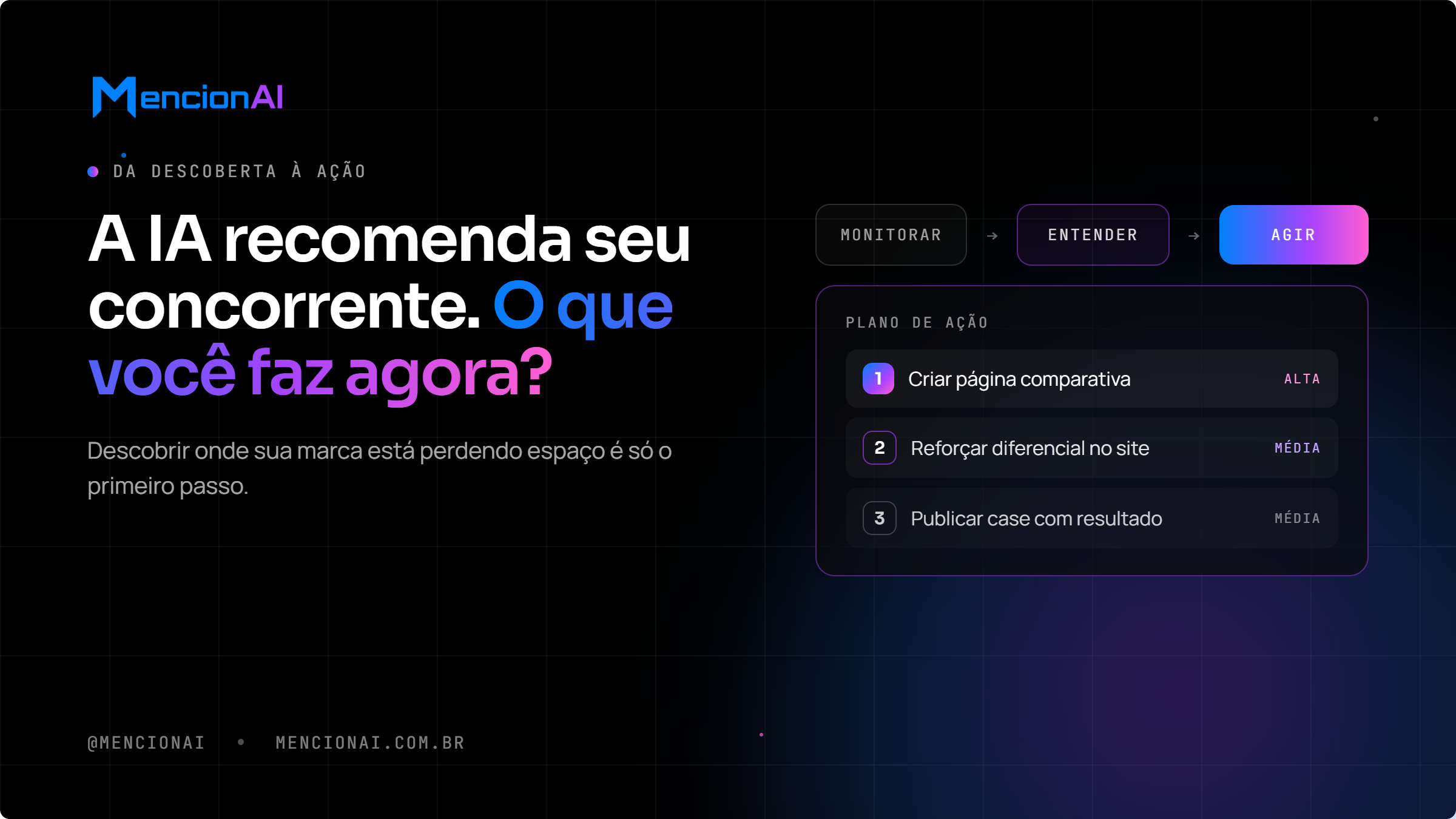
This is why we built MencionAI. We monitor how and when your brand appears in major AIs every day and provide a practical action plan for each gap found.
If you want to see how this works for your brand, just schedule a demo.
Pedro, CMO of MencionAI
Frequently Asked Questions
Does GEO replace SEO? No. SEO ranks links on the SERP. GEO measures if your brand is cited in the responses of ChatGPT, Gemini, Claude, Perplexity, Grok, and DeepSeek.
What should I publish first to be cited by AIs? Comparative pages, FAQs with stable anchors, llms.txt, and schema for Organization — then re-scan the same prompts.
What is E-E-A-T and how does it help with AI citations? Google Search Central describes E-E-A-T as experience, expertise, authority, and trust — trust first. Named authors, firsthand experience, and citations to official documents help judge who signs the page. Structured data is not required for AI Overviews, but Article, Person, and Organization still help Search understand the author and publisher.
FAQ
Is GEO a replacement for SEO?
No. SEO ranks links on a results page. GEO measures whether your brand is cited inside AI answers on ChatGPT, Gemini, Claude, Perplexity, Grok, and DeepSeek.
What should we publish first for AI citations?
Comparison pages, FAQ hubs with stable anchors, llms.txt, and Organization schema — then re-scan the same prompts.
What is E-E-A-T and how does it help AI citations?
Google Search Central describes E-E-A-T as experience, expertise, authoritativeness, and trustworthiness — trust first. Named authors, first-hand experience, and citations to official docs help people judge who stands behind the page. Structured data is not required for AI Overviews, but Article, Person, and Organization markup still help Search understand the author and publisher.
Sources
- Google Search Central — helpful, people-first content (E-E-A-T)
- Google Search Central — AI-generated content
- Google Search Central — generative AI features on Search
- Google AI features (AI Overviews and AI Mode)
- Google Search Central — Article structured data
- Google Search Central — Organization structured data