Share of Voice: Who Occupies the Space That Could Be Yours
MencionAI Blog Pedro Vianna Quintian
MencionAI Blog Sep 30, 2026 · 3 min read / Monitoring
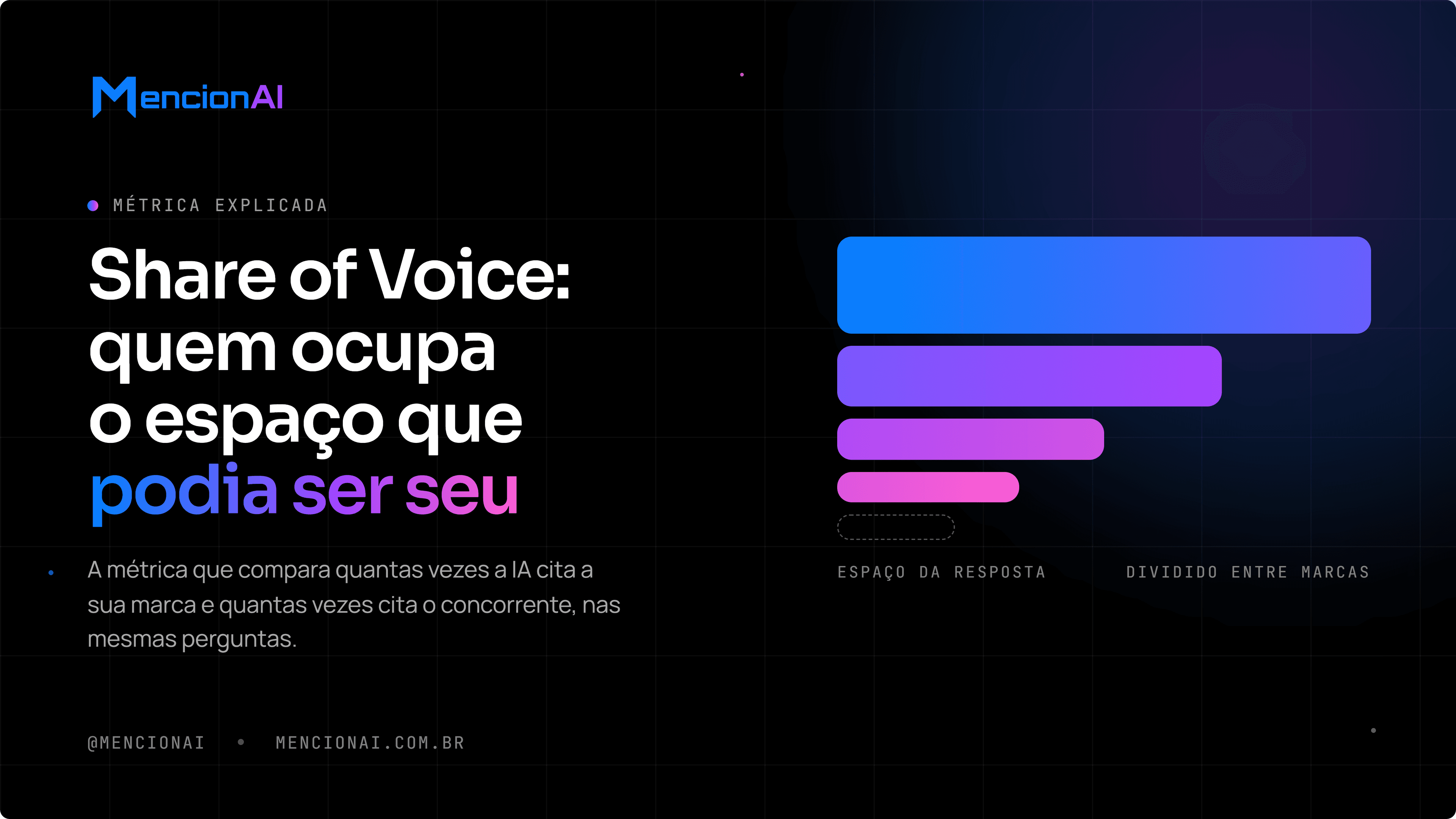
Knowing that your brand appeared in an AI response only answers half the question. The other half is how much of that space is yours compared to what competitors occupy in the same prompts. This second half has a name: Share of Voice.
Quick answer
No. SEO ranks links on a results page. GEO measures whether your brand is cited inside AI answers on ChatGPT, Gemini, Claude, Perplexity, Grok, and DeepSeek.
Summary
- Share of Voice measures how much of the response space on a topic belongs to your brand compared to what competitors occupy in the same prompts.
- A brand may appear in an AI response today and disappear in the next execution of the same prompt, while a competitor appears almost every time.
- Running the same category prompt multiple times across various models allows you to count how many executions mention your brand and how many mention each competitor.
- Tracking Share of Voice over time shows whether your brand's space is growing, shrinking, or stagnant, and reveals who you are really competing against for the response, sometimes quite different from who you thought bef
- What is Share of Voice in AI responses? It is the metric that measures how much of the response space on a topic is occupied by your brand compared to what competitors occupy in the same prompts over multiple executions.
Why an Isolated Appearance Doesn’t Tell the Whole Story
A brand may appear in an AI response today and disappear in the next execution of the same prompt, while a competitor appears almost every time. Looking only at whether the brand appeared once hides this difference. Share of Voice changes the angle of the question from "Did I appear?" to "In how many of these executions do I appear, and how much of that is mine compared to what each competitor occupies?".
How This Appears in Practice
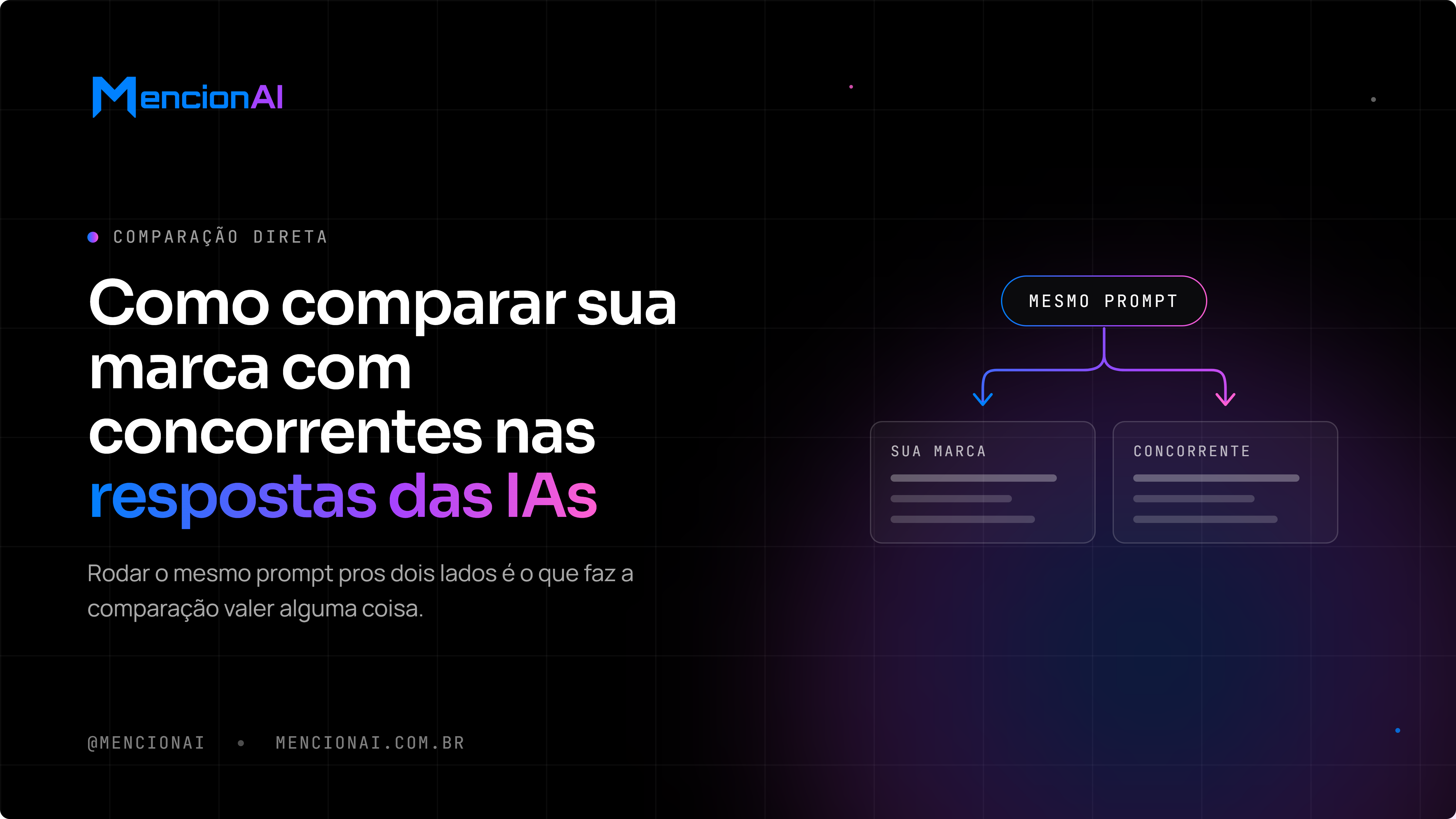
Running the same category prompt multiple times across various models allows you to count how many executions mention your brand and how many mention each competitor. If your brand appears in few executions and a competitor appears in most of them, this indicates a low Share of Voice, even if your brand appears occasionally. The metric only makes sense when comparing your brand against competitors within the same set of prompts, never in isolation.
What the Metric Reveals Over Time
Tracking Share of Voice over time shows whether your brand's space is growing, shrinking, or stagnant, and reveals who you are really competing against for the response, sometimes quite different from who you thought before looking at the data. This is why MencionAI measures Share of Voice prompt by prompt, comparing your brand with registered competitors instead of treating each appearance as an isolated result.
If you want to know how much of your category's space is yours, just schedule a demo.
Pedro, CMO of MencionAI
Frequently Asked Questions
What is Share of Voice in AI responses? It is the metric that measures how much of the response space on a topic is occupied by your brand compared to what competitors occupy in the same prompts over multiple executions.
Is Share of Voice the same as ranking or position? No. Ranking implies an ordered list, and not every AI response provides that. Share of Voice counts how many executions include your brand and how many include each competitor, regardless of whether there is an explicit order in the response.
Can Share of Voice be measured with a single question asked in an AI? Not reliably. The metric compares your brand against competitors over multiple executions of the same prompt because a single response does not show the pattern of who occupies more space over time.
Why can low Share of Voice happen even if my brand has appeared at some point? Because the metric looks at the proportion between executions, not an isolated appearance. If a competitor appears in most executions and your brand appears only occasionally, your brand's Share of Voice is low, even with some recorded presence.
FAQ
Is GEO a replacement for SEO?
No. SEO ranks links on a results page. GEO measures whether your brand is cited inside AI answers on ChatGPT, Gemini, Claude, Perplexity, Grok, and DeepSeek.
What should we publish first for AI citations?
Comparison pages, FAQ hubs with stable anchors, llms.txt, and Organization schema — then re-scan the same prompts.
What is E-E-A-T and how does it help AI citations?
Google Search Central describes E-E-A-T as experience, expertise, authoritativeness, and trustworthiness — trust first. Named authors, first-hand experience, and citations to official docs help people judge who stands behind the page. Structured data is not required for AI Overviews, but Article, Person, and Organization markup still help Search understand the author and publisher.
Sources
- Google Search Central — helpful, people-first content (E-E-A-T)
- Google Search Central — AI-generated content
- Google Search Central — generative AI features on Search
- Google AI features (AI Overviews and AI Mode)
- Google Search Central — Article structured data
- Google Search Central — Organization structured data