Success Stories: Brazilian Companies Dominating AI Visibility with GEO
MencionAI Blog Vinícius Guimarães de Oliveira
MencionAI Blog May 18, 2026 · 6 min read / Market
The race for attention in search has changed. Today, beyond Google, companies need to appear in AI answers from ChatGPT, Perplexity, Gemini, and enterprise copilots. In Brazil, brands that started early with Generative Engine Optimization (GEO) are already seeing concrete results: more mentions, more citations, and more influence over purchase decisions.
Quick answer
No. SEO ranks links on a results page. GEO measures whether your brand is cited inside AI answers on ChatGPT, Gemini, Claude, Perplexity, Grok, and DeepSeek.
Summary
- Dominating AI visibility is not just about “showing up” in answers.
- Some Brazilian fintechs have been gaining ground in AI answers about credit cards, PIX, investing, and financial planning.
- Brazilian B2B software companies have also moved fast in AI visibility, especially in niches like CRM, automation, customer support, HR, and productivity.
- In Brazilian digital retail, brands with large catalogs have been using GEO to appear in purchase-intent queries such as “what is the best value-for-money laptop?
- Although they operate in different segments, Brazilian companies with the best AI visibility results share some very clear habits: 1.
- The main lesson is simple: AI visibility does not happen by chance.
What it means to “dominate AI visibility” in practice
Dominating AI visibility is not just about “showing up” in answers. It means being cited consistently, with the right context, and at decisive moments in the user journey. In practical terms, this involves three pillars:
- Being recognized as a trusted source for a specific topic.
- Having structured content so models can find and reuse information easily.
- Building authority signals off-site, such as mentions in media outlets, communities, comparison pages, and partner pages.
Brazilian companies standing out in GEO have understood that AI does not “guess” authority; it observes it through patterns. When there is topical clarity, recurring presence, and editorial consistency, the likelihood of citation rises significantly.
Case 1: fintechs that turned financial education into an AI asset
Some Brazilian fintechs have been gaining ground in AI answers about credit cards, PIX, investing, and financial planning. The secret is not just publishing generic articles, but building a highly useful content ecosystem:
- explanatory pages about financial terms;
- product comparisons;
- updated glossaries;
- direct answers to recurring questions;
- content with data, tables, and local examples.
This type of strategy helps models identify the brand as a trusted source in personal finance. When users ask, for example, “what is the best digital account for MEIs in Brazil?” or “how does credit card installment payments work?”, these companies have a better chance of appearing because they offer clear, specific, and semantically rich content.
The key difference is that these brands do not treat the blog as a traffic channel only, but as a knowledge base. In GEO, that matters a lot: the more a company answers real questions accurately, the stronger its presence tends to be in AI answer layers.
Case 2: B2B SaaS companies that became category references
Brazilian B2B software companies have also moved fast in AI visibility, especially in niches like CRM, automation, customer support, HR, and productivity. The most common pattern among winners is the creation of category content.
Instead of speaking only about their own product features, these companies produce:
- “best tools for X” guides;
- solution comparison pages;
- market analyses;
- content about operational pain points in the industry;
- benchmarks and proprietary reports.
This approach increases the chances of being cited when AI answers questions like “what are the best CRMs for small businesses in Brazil?” or “which platform should I use for customer onboarding?”.
Another important factor is external visibility. By earning mentions in specialized publications, reviews, communities, and comparison lists, these companies expand their “authority trail” — a signal AI engines use to validate relevance. In practice, GEO for SaaS is not just SEO under another name; it is a positioning strategy to stay top of mind for systems that synthesize recommendations.
Case 3: e-commerce brands that became product-answer sources
In Brazilian digital retail, brands with large catalogs have been using GEO to appear in purchase-intent queries such as “what is the best value-for-money laptop?” or “where can I buy running shoes with the best durability?”.
The companies that stand out most usually follow these practices:
- complete product pages with original descriptions;
- detailed FAQs by category;
- real user reviews;
- consistent use of technical attributes;
- editorial content connecting problem, solution, and product.
Together, these elements help AI understand not only what the brand sells, but who it serves and in which contexts it is relevant. When content is well structured, the likelihood of citation increases because AI can extract useful and trustworthy snippets more easily.
In addition, e-commerce businesses that monitor AI mentions quickly see which products are being recommended and which categories are invisible. This feedback speeds up improvements in pages, descriptions, and information architecture.
The common pattern among Brazilian companies winning in GEO
Although they operate in different segments, Brazilian companies with the best AI visibility results share some very clear habits:
1. Editorial consistency
They publish frequently and keep content continuously updated. AI favors living sources that show maintenance and relevance over time.
2. Semantic clarity
Content is written to answer questions directly. Titles, subtitles, lists, and definitions make it easier for humans and machines to read.
3. Distributed authority
These brands do not rely only on their own website. They also build presence in digital PR, comparison pages, communities, podcasts, newsletters, and third-party pages.
4. Citation monitoring
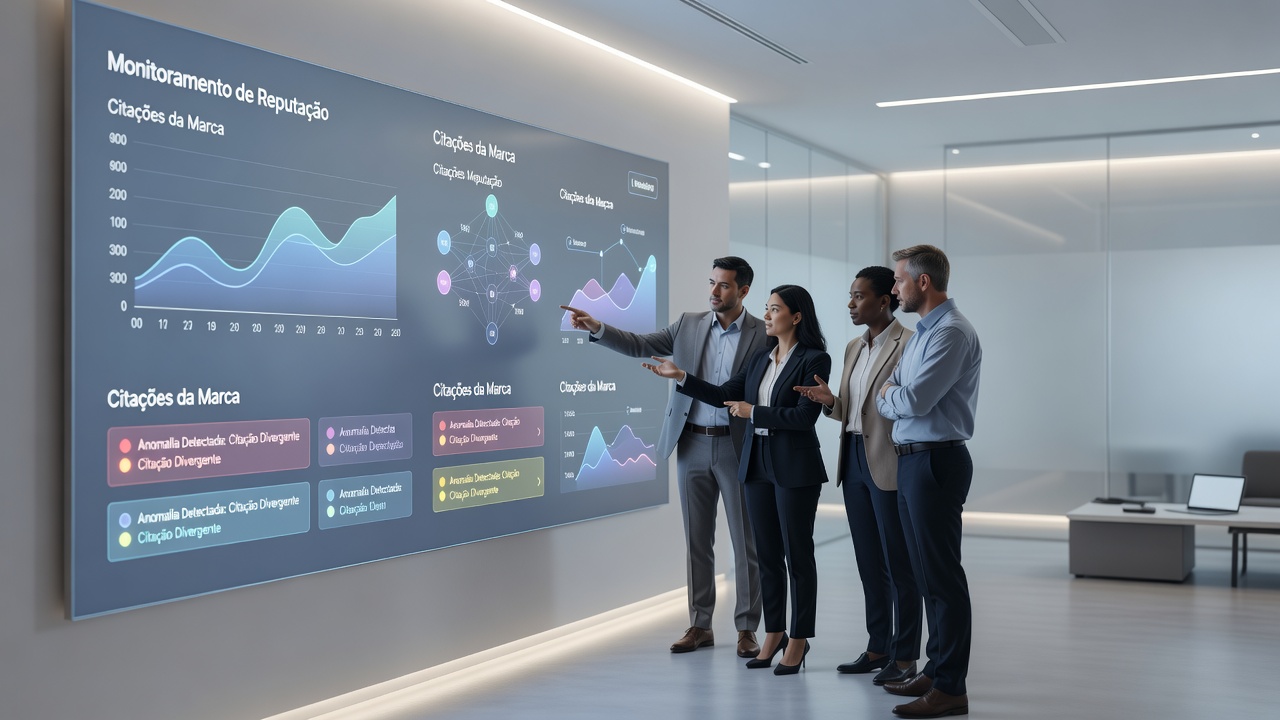
Those leading GEO measure what is happening. Monitoring AI mentions makes it possible to adjust content quickly and understand which topics are gaining traction.
5. Topic focus, not just keywords
Instead of trying to rank for isolated terms, these companies build topic clusters. This increases the chance of being seen as a reference for a complete subject.
What your company can learn from these cases
The main lesson is simple: AI visibility does not happen by chance. It is the result of a combination of useful content, external authority, and structure designed for generative systems.
If your company wants to follow the path of Brazilian brands that are already standing out, start with three fronts:
- find out which questions your audience actually asks;
- organize answers into clear, reusable formats;
- monitor where and how your brand is being cited by AI.
This process creates a virtuous cycle: the more the company is cited, the more it learns; the more it learns, the more it optimizes; the more it optimizes, the more it appears.
GEO is the new competitive layer of search
In the Brazilian market, companies that understood this shift early are already pulling ahead. They are not just competing for clicks — they are competing for space inside the answers that shape opinion, comparison, and decision.
For founders and marketers, the opportunity is huge. In many sectors, there is still little organized competition in GEO. That means that investing now in AI visibility can secure a position that is hard to dislodge later.
If the goal is to be remembered by AI when customers ask, the strategy needs to start now. And in today’s landscape, mastering GEO is one of the most efficient ways to build that advantage.
FAQ
Is GEO a replacement for SEO?
No. SEO ranks links on a results page. GEO measures whether your brand is cited inside AI answers on ChatGPT, Gemini, Claude, Perplexity, Grok, and DeepSeek.
What should we publish first for AI citations?
Comparison pages, FAQ hubs with stable anchors, llms.txt, and Organization schema — then re-scan the same prompts.
What is E-E-A-T and how does it help AI citations?
Google Search Central describes E-E-A-T as experience, expertise, authoritativeness, and trustworthiness — trust first. Named authors, first-hand experience, and citations to official docs help people judge who stands behind the page. Structured data is not required for AI Overviews, but Article, Person, and Organization markup still help Search understand the author and publisher.
Should Brazilian brands optimize in Portuguese, English, or both?
Both. Brazilian B2B buyers mix PT-BR and English prompts. Publish citable PT-BR pages first, keep stable English canonicals for global models, and measure ChatGPT, Gemini, Claude, Perplexity, Grok, and DeepSeek in Brazil.